


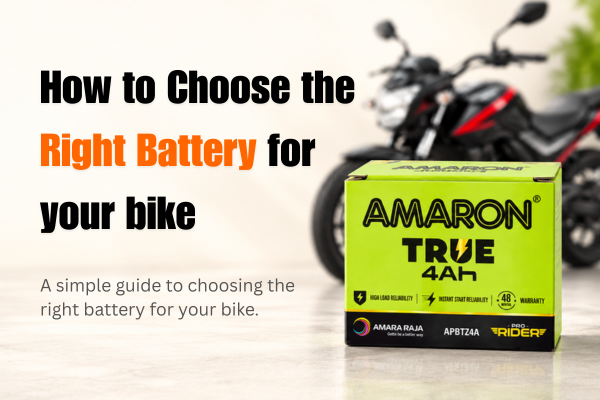
How to Choose the Right Battery for Your Bike
Your bike struggles to start, the horn sounds weak, and you’re already running late. You search for a replacement battery and find several options with different prices, sizes and Ah ratings. Which one should you buy?
Choosing the right bike battery starts with compatibility—not the biggest capacity or the lowest price. You need a battery that matches your motorcycle’s electrical requirements, fits its battery tray and comes with clear warranty support.
This bike battery buying guide explains what to check before ordering online, whether you ride through Delhi traffic or commute elsewhere in India.
Why Choosing the Correct Bike Battery Matters
A replacement battery must suit your bike’s model and electrical system. Amaron recommends checking the owner’s manual, capacity, dimensions and terminal positions before selecting a two-wheeler battery.
However, a starting problem does not automatically mean you need a new battery. Exide warns that a faulty electrical system can damage the battery. If yours repeatedly goes flat, have the battery and charging system checked before buying another one.
How to Choose the Right Battery for Your Bike: 6 Steps
Step 1: Identify Your Bike’s Exact Model
Write down your bike’s:
- Brand and model
- Variant and manufacturing year
- Engine capacity
- Existing battery model code
Check the owner’s manual and the battery manufacturer’s vehicle-fitment guide. Don’t assume that every motorcycle with the same engine capacity uses the same battery. Select a replacement listed for your exact application.
Step 2: Match the Voltage and Capacity
Check these two specifications:
- Voltage (V): Match the voltage specified for your motorcycle.
- Capacity (Ah): Ampere-hours describe battery capacity; use the manufacturer-recommended rating or an explicitly approved equivalent.
A higher Ah number alone does not prove compatibility. For example, Amaron lists one 12V, 4Ah battery measuring 113 × 70 × 85 mm and another 12V, 5Ah battery measuring 113 × 70 × 105 mm. The second is taller despite having the same length and width.
“More powerful” is not a fitment specification.
Step 3: Check Dimensions and Terminal Positions
Before buying a bike battery online, confirm:
- Length, width and height
- Positive and negative terminal positions
- Terminal type
- Compatibility with the retaining bracket
Amaron specifically advises matching the battery dimensions and terminal locations to the motorcycle. A battery that looks similar in a photograph may still be unsuitable.
Step 4: Choose the Correct Battery Type
Conventional and AGM batteries have different maintenance requirements. AGM means Absorbent Glass Mat, a construction that holds the electrolyte in glass-mat separators. Yuasa explains that its AGM batteries require no water top-ups once correctly activated.
| Factor | Conventional flooded battery | Maintenance-free AGM battery |
| Maintenance | May require electrolyte checks and top-ups | No routine water top-ups |
| Construction | Liquid electrolyte | Electrolyte absorbed in glass mat |
| Buying priority | Confirm fitment and maintenance instructions | Confirm fitment and activation requirements |
| Suitability | Applications specifying this type | Applications approving this type |
Neither type is automatically right for every motorcycle. Yuasa notes that not all bikes call for AGM batteries; follow the application guide rather than choosing by label alone.
Step 5: Review Starting Requirements and Usage
Where specified, check CCA—Cold Cranking Amps—which indicates cold-weather starting capability. Amaron includes CCA among its battery-selection considerations. Match the bike’s requirements rather than buying solely on the largest advertised figure.
Also tell the seller about additional lights or electronics. Accessory loads are relevant to selection, but battery capacity should still match the motorcycle’s approved requirements.
Step 6: Compare the Seller, Warranty and Total Price
Before paying, check:
| Factor | What to confirm |
| Fitment | Exact bike model and variant |
| Specifications | Voltage, Ah, dimensions and polarity |
| Seller | Business details and working contact information |
| Invoice | Battery model and purchase details |
| Warranty | Free-replacement and pro-rata periods |
| Delivery | Charges and serviceability for your PIN code |
| Returns | Conditions for incorrect fitment or transit damage |
| Exchange | Whether the price includes an old-battery exchange |
Read warranty terms carefully. Exide distinguishes free replacement from pro-rata coverage; the total advertised warranty is not necessarily an entirely free-replacement period.
What to Check When Your Battery Arrives
Before installation:
- Match the model code and specifications with your order.
- Inspect the casing and terminals for damage.
- Check for leakage or signs of tampering.
- Confirm the invoice and warranty information.
- Follow the manufacturer’s activation instructions.
Some batteries are factory-activated, while others require preparation. Don’t assume every battery is ready to install immediately. Keep metal tools from bridging the terminals, and arrange professional installation if you’re unsure.
Common Mistakes When Buying a Bike Battery Online
- Choosing only by price.
- Assuming every 12V battery will fit.
- Ignoring battery height and terminal positions.
- Buying higher capacity without checking approved fitment.
- Treating a long warranty as entirely free replacement.
- Replacing the battery without investigating repeated discharge.
The better approach is to verify fitment first, then compare cost and warranty—not the other way around.
Buying a Bike Battery in Delhi
If you’re comparing bike batteries in Delhi, online listings can help you organise specifications and prices before ordering.
Confirm delivery to your PIN code, installation arrangements and where warranty claims will be handled. For local assistance, Kunasha Automart lists its business address in Laxmi Nagar, Delhi, and a contact number on its website.
FAQs
How do I find the correct battery for my bike?
Start with your owner’s manual and a battery manufacturer’s vehicle-fitment guide. Note your motorcycle’s model, variant and year, then compare the recommended battery code, voltage, capacity, dimensions and terminal positions. Use the existing battery label as a cross-check, rather than your only reference.
Can I use a higher Ah battery?
Do not select a higher Ah battery solely because it sounds better. First confirm that the replacement is approved for your motorcycle and matches its dimensions, terminal layout and electrical requirements. A higher-capacity battery can have a different case size, as Amaron’s product specifications demonstrate.
Is a maintenance-free battery better?
A maintenance-free AGM battery removes the need for routine water top-ups, which can make ownership simpler. However, convenience does not establish compatibility. Choose it only when the manufacturer’s application guidance supports your bike, and check whether it arrives factory-activated or requires preparation before use.
Does a starting problem mean the battery needs replacing?
Not necessarily. A charging-system problem may affect the battery, and replacing it without investigating could leave the underlying fault unresolved. Exide recommends checking the regulator-rectifier and battery voltage regularly. Have the battery and charging system tested, particularly if the problem returns after charging or replacement.
What should I check in a bike battery warranty?
Check the free-replacement period, pro-rata period, claim process and required purchase records. These are not interchangeable: pro-rata coverage generally involves a discounted replacement rather than a free one. Exide’s terms distinguish these periods, so read the conditions for the exact battery model before paying.